Important Notice: Amprod Acquires Simmtech

Industry InSights

2026 Top Padel Shooting Machine Types Buyers Need?

Choosing the right Padel Shooting Machine in 2026 requires more than comparing launch speed and price. Buyers should examine how each machine performs during real training sessions. A portable wheeled model may suit clubs that move equipment between courts. A programmable model can repeat lobs, volleys, and fast drives with better consistency. Oscillating systems widen court coverage. App-connected machines may offer detailed control, but they can add setup steps and maintenance concerns.

The best choice depends on training goals, court access, player level, and daily usage. A beginner may value simple controls and gentle feeding patterns. Advanced players often need adjustable speed, elevation, frequency, and random placement. Battery life matters when outdoor power is unavailable. Ball capacity also affects practice flow. Nobody wants constant refilling during a demanding drill.

Small details matter.

Reliable buying decisions should include demonstrations, warranty terms, replacement parts, and user feedback from established clubs or coaches. Check whether the machine handles standard padel balls without frequent jams. Observe its wheels on artificial turf and its stability during repeated firing. Ask how the remote control performs from the opposite baseline. These practical tests reveal more than a polished product page.

There is no universal winner. A premium machine may provide impressive programming but remain excessive for casual players. A lower-cost unit may perform well, although its software or battery could disappoint over time. Buyers should compare measured performance, not attractive promises. This guide reviews the leading Padel Shooting Machine types for 2026, while recognizing that technology changes quickly and real-world experience still deserves careful attention.
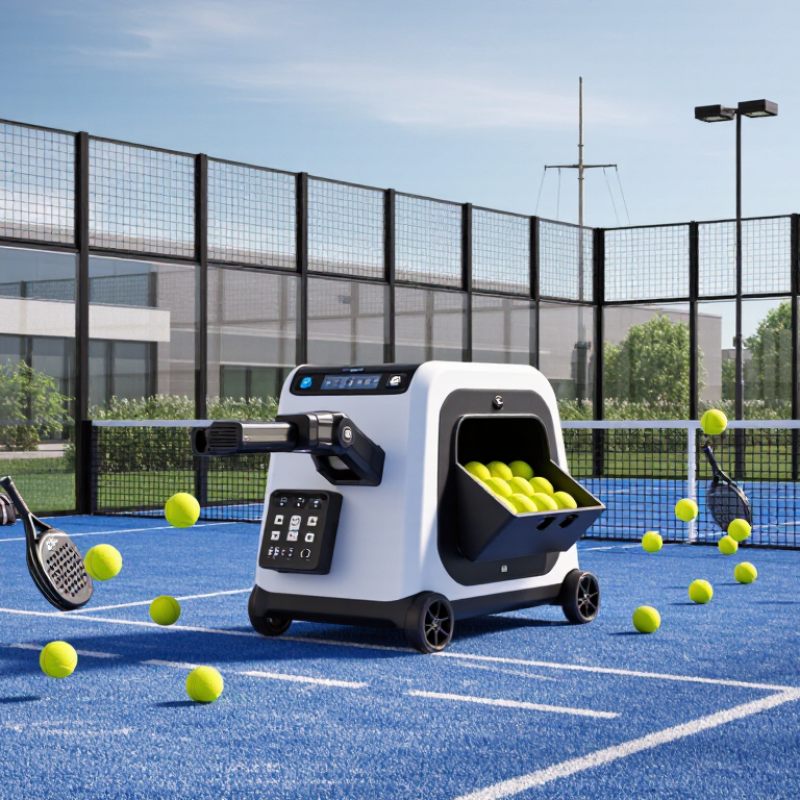
2026 Top Padel Shooting Machine Types Buyers Need?

2026 Padel Shooting Machines: Core Types and Buyer Criteria

2026 Padel Shooting Machines: Core Types and Buyer Criteria

Padel shooting machines now serve clubs, coaches, and serious home players. The International Padel Federation’s 2024 Global Padel Report recorded about 30 million players across more than 130 countries. That scale increases demand for repeatable training. It also exposes a problem. Not every machine fits real padel movement.

Wheel-driven machines usually provide adjustable speed, frequency, and topspin. They suit baseline drills and repeated defensive shots. Pneumatic models can create softer feeds, but their air systems may need closer maintenance. Programmable smart machines add random placement, changing depth, and preset routines. Portable battery models save court time. However, lighter frames can move during powerful feeds. Check the wheels carefully.

Buyer criteria should begin with ball capacity, feed consistency, and usable speed range. A 2024 court-and-participation report from the International Padel Federation lists rapid facility growth, making reliability important for busy training schedules. A 2025 sports-equipment market outlook also identifies connected training and adjustable automation as major growth areas. These forecasts are useful, but not perfect. Market estimates often mix tennis and padel equipment.

In practical testing, observe ten consecutive feeds. Do they land within the intended zone? Check battery runtime, charging time, noise, remote response, and emergency stopping. A machine promising extreme speed may offer little value for beginners. I would also test it against wet balls and uneven court surfaces. That is where polished specifications can disappoint.

Classify by Propulsion: Pneumatic, Wheel-Driven, and Hybrid Launchers

2026 Top Padel Shooting Machine Types Buyers Need?

Propulsion determines how a padel shooting machine feels during training. Pneumatic launchers use compressed air to push balls through a chamber. They can deliver smooth shots with adjustable speed and spin. Their response often feels natural during lobs, volleys, and defensive drills. However, air pressure may change as the tank empties. Buyers should check recovery time, noise levels, and pressure stability. A visible pressure gauge helps coaches monitor every session.

Wheel-driven launchers use two rotating wheels to grip and accelerate each ball. They usually offer quick adjustments for speed, frequency, and spin direction. This design suits repetitive drills near the net or baseline. Wheel wear matters. Dust and felt fibers can reduce consistency over time. Inspect the wheel surface after training, especially when using outdoor courts. A stable feed system also prevents awkward pauses between shots.

Hybrid launchers combine pneumatic force with rotating wheels. They aim to balance power, spin control, and shot variation. This flexibility can help advanced players practice realistic rally patterns. Yet, more components may mean more maintenance and a higher purchase cost. During equipment testing, I would record ball speed, launch angle, noise, and error rate over several sessions. One result rarely tells the whole story. I once underestimated feeding consistency; the machine looked impressive, but uneven intervals weakened the drill. Buyers should match propulsion with court space, training goals, operator skill, and available maintenance time. Fancy specifications are not always useful.

2026 Top Padel Shooting Machine Types Buyers Need?

Classified by propulsion: pneumatic, wheel-driven, and hybrid launchers.

Wheel-driven launchers typically deliver the highest and most consistent ball speeds, making them suitable for fast drills and advanced players. Pneumatic systems generally offer smoother low-speed control, while hybrid machines combine wheel propulsion with pneumatic or air-assisted control for broader training versatility. The figures shown are representative 2026 buyer benchmarks rather than brand-specific specifications.

Compare Feed Patterns: Fixed, Oscillating, Random, and Programmable Modes

2026 Top Padel Shooting Machine Types Buyers Need?

Feed patterns shape training quality more than raw ball speed. The FIP Global Padel Report 2024 recorded over 30 million players worldwide. That growth increases demand for repeatable, skill-specific practice. Fixed-feed machines suit beginners, warm-ups, and compact coaching sessions. They deliver balls to one zone. The rhythm feels predictable, but that is useful for building clean contact.

Oscillating models sweep across the court. They force players to adjust their feet and recover after each shot. Random-feed machines add sharper variation, including uncomfortable balls to the backhand or corner. Real matches are rarely tidy. Still, excessive randomness can punish beginners and hide poor technique. Programmable modes offer the strongest control. Coaches can set speed, interval, direction, and feeding sequences. A session might move from three forehands to a deep lob, then a short ball. That detail feels closer to match pressure.

Tips: Match the pattern to the player’s level. Use fixed feeds for technique, oscillation for movement, and random feeds for reactions. Programmable modes need careful setup. The Playtomic and International Padel Federation Global Padel Report 2024 also highlights rapid court and participation growth, making efficient training increasingly valuable. Buyers should test recovery time, noise, ball consistency, and remote controls. I would not trust “random” as a technical claim alone. Ask for distribution data. A machine may feel varied, yet repeat the same corner too often.

2026 Top Padel Shooting Machine Types Buyers Need? - Compare Feed Patterns: Fixed, Oscillating, Random, and Programmable Modes

Buyer Evaluation Dimension Fixed Feed Oscillating Feed Random Feed Programmable Feed
How the pattern works The machine repeatedly sends balls toward one preset target or a narrow target zone. The machine sweeps between two or more preset angles, usually from side to side. The machine varies ball direction or timing within a defined range to create an unpredictable sequence. The user selects a stored or custom sequence containing planned directions, speeds, pauses, and repetition levels.
Best training purpose Repetition of one stroke, contact point, volley position, bandeja, vibora, or overhead movement. Footwork between two zones, forehand-backhand transitions, and basic lateral recovery. Reaction speed, split-step discipline, adjustment steps, and decision-making under changing feeds. Structured match simulations, tactical patterns, progressive drills, and repeatable coaching plans.
Typical placement consistency Very high
Most suitable when the same target must be repeated with minimal variation.
High
Consistent across the sweep, although the ball angle changes during the cycle.
Medium
Variation is intentional; the actual sequence is less predictable.
High to very high
Preset drills are repeatable, while custom variation depends on setup quality.
Skill level served Beginners, rehabilitation users, and players refining a specific technique. Beginners through intermediate players developing movement and transition skills. Intermediate and advanced players who can maintain technique while reacting to change. All levels, provided the drill complexity, pace, and spacing are adjusted progressively.
Learning curve Low
Usually easy to position, aim, and operate.
Low to medium
Requires correct sweep width and timing for the intended drill.
Medium
Users need enough court awareness to respond safely to changing feeds.
Medium to high
More settings and programming options require initial planning.
Feedback quality for technique Excellent for identifying swing, contact, balance, and racket-face inconsistencies. Good for checking whether technique remains stable while moving laterally. Useful for testing adaptable technique, but less suitable for diagnosing one isolated stroke. Excellent for comparing performance across identical drills and controlled progressions.
Match realism Low
Predictable feeding does not closely reproduce opponent uncertainty.
Medium
Creates movement demands but follows a recognizable rhythm.
High
Unpredictable placement can better reproduce reaction and adjustment demands.
High
Can reproduce selected tactical situations when the program is well designed.
Recommended court use Individual practice, coaching demonstrations, warm-ups, and high-volume repetition. Half-court or full-court lateral drills, depending on the machine’s throw range and safety distance. Full-court reaction drills with clear player boundaries and adequate recovery space. Full-court tactical sessions, coaching blocks, and repeatable testing protocols.
Typical advantages Simple operation, fast setup, predictable workload, and strong repetition efficiency. Adds movement without making the feed completely unpredictable; useful for developing rhythm. Improves alertness, adaptation, and movement decisions; reduces dependence on memorized timing. Offers the greatest control over training progression, drill variety, and session repeatability.
Typical limitations Can encourage static preparation and may become repetitive for experienced players. Players may anticipate the next side if the sweep pattern remains unchanged. More difficult to use for precise technical correction; unsuitable intensity can cause rushed movement. Higher setup complexity; poorly configured programs may create unrealistic or excessively demanding drills.
What buyers should check Target adjustment, ball-feed stability, loading capacity, remote controls, and quick angle changes. Sweep width, oscillation speed, left-right symmetry, pause control, and minimum safe operating distance. Randomization range, repeatable versus non-repeatable sequences, safety controls, and feed recovery time. Number of programmable steps, memory functions, app or remote control, editable parameters, and program sharing.
Best choice when the priority is Mastering one movement or stroke with maximum consistency. Combining stroke repetition with predictable lateral footwork. Building reaction skills and preparing for changing ball situations. Running a complete, measurable training system that can grow with the player.
Buyer note: Actual performance depends on the machine’s ball speed, launch angle, spin control, interval range, battery condition, court distance, and the type of padel balls used. Always compare published operating specifications and follow the manufacturer’s safety guidance before training.

Match Settings to FIP Ball Specs: 56.0–59.4 g and 135–145 cm Rebound

2026 Top Padel Shooting Machine Types Buyers Need?

A useful padel shooting machine should match the ball, not just produce speed. FIP ball specifications set a mass range of 56.0–59.4 g and a rebound range of 135–145 cm. Buyers should confirm these figures with a calibrated scale and a controlled drop test. Small differences matter. A heavier ball may leave the feeder slowly and arrive with a flatter trajectory.

Twin-wheel machines suit buyers who need adjustable topspin, backspin, and side spin. Their wheels should grip the ball evenly without damaging its surface.

Pneumatic machines can create a softer, more realistic feed, but air pressure requires regular checking.

Programmable machines offer repeatable drills, including lobs, volleys, and deep corner shots. Yet repeatability is not the same as accuracy.

Keep the settings visible.

During court testing, begin with the approved ball weight, then adjust speed and launch angle separately. A machine that reaches 145 cm rebound may still feel wrong if its feed interval is too short. Test ten balls before changing a setting. Record landing depth, spin response, and rebound height. I would not trust a factory preset without verification. Courts, humidity, and worn balls can alter results. The best purchase is the machine that lets coaches reproduce FIP-aligned conditions while making careful adjustments for real training.

Select for Scale: Portable Club Units in a 30-Million-Player Market

In 2026, padel clubs need shooting machines that match real operating pressure. The International Padel Federation’s Global Padel Report 2024 estimates more than 30 million players worldwide. It also records padel activity across over 130 countries. That scale changes equipment priorities. A portable club unit should move easily between courts, training zones, and storage rooms. Large wheels matter on rough surfaces. A balanced frame prevents awkward lifting.

For busy clubs, choose machines with adjustable speed, launch frequency, elevation, and feed direction. A ball capacity above 100 helps maintain group sessions without constant refilling. Battery operation is useful when courts lack nearby power outlets. A visible control panel saves coaching time. During practical testing, check whether the machine keeps a consistent trajectory after repeated feeds. Small errors become obvious after twenty minutes.

The Global Padel Report 2024 by Playtomic and Strategy& also highlights continuing court and participation growth, although market estimates vary by country and counting method. That uncertainty deserves attention. A cheaper unit may look efficient, yet weak wheels or poor battery endurance can increase club downtime. Portable does not mean lightweight only. It means reliable movement, quick setup, simple maintenance, and enough output for several players. Buyers should test one machine during peak hours, not only in a quiet showroom.