What Is a Copper Tap and How Do You Choose One?
A Copper Tap is more than a warm metallic feature beside a sink. It is a working plumbing component, exposed to water chemistry, pressure, cleaning products, and daily handling. Its value depends on the complete assembly, not copper’s attractive color alone.
The World Health Organization’s Guidelines for Drinking-water Quality identify copper as an essential nutrient, while noting that excessive exposure can create health concerns. In the United States, the Environmental Protection Agency sets a 1.3 mg/L action level for copper under the Lead and Copper Rule. These figures do not make every Copper Tap automatically safe. Certification, internal materials, installation quality, and local water conditions still matter. As Andy Kireta Jr. of the Copper Development Association has stated, “Copper is durable, reliable, and recyclable.” That remains useful advice, but it is not a complete buying rule.
Market research from Grand View Research places the global faucets market at approximately USD 39 billion in 2023, with continued growth expected through 2030. The wider market is expanding. Product quality is uneven. When choosing a Copper Tap, check the waterway material, cartridge type, pressure rating, finish durability, and compliance marks such as NSF certification. A solid brass body may perform well, yet a poor cartridge can still cause leaks. A polished surface can hide weak internal parts. That assumption deserves testing.
The right choice also depends on your sink, water hardness, maintenance habits, and budget. A beautiful tap that stains quickly may become a daily annoyance. Good decisions require specifications, not showroom shine.
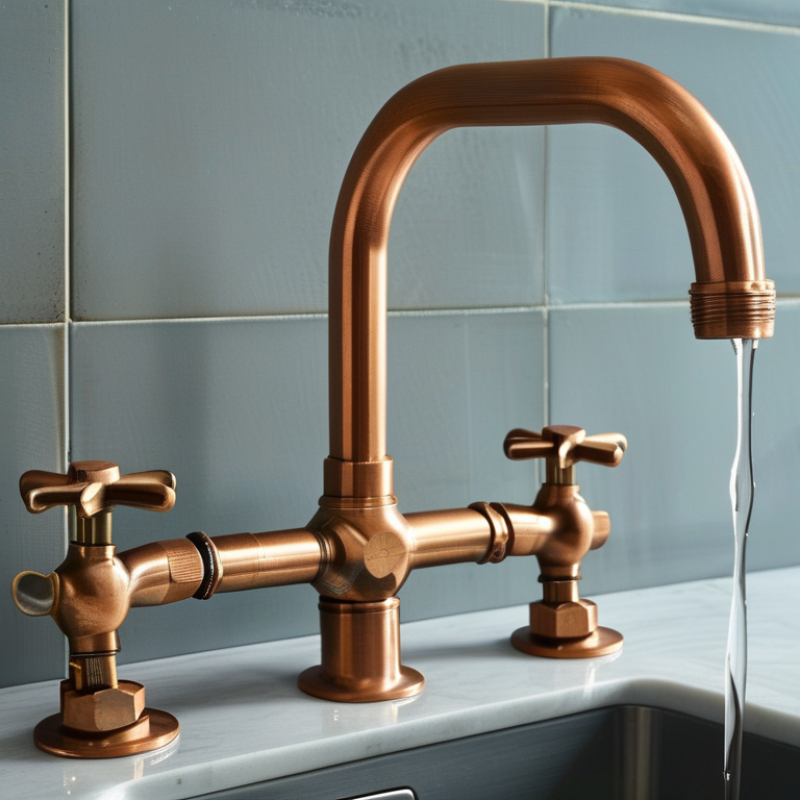
What Defines a Copper Tap: Solid Copper, Brass, or Copper-Finish Models
A copper tap can mean three different things: solid copper, brass, or a copper-finish model. These materials may look similar under warm lighting, but they perform differently in daily use.
Solid copper contains copper throughout the body. It develops a deeper brown or greenish patina when exposed to air and moisture. This changing surface appeals to people who like visible age. However, copper is relatively soft and can show scratches or dents more easily. Check the product specifications carefully. “Copper tap” does not always mean pure copper.
Brass is a copper-zinc alloy and is widely used for tap bodies, valves, and internal fittings. It generally offers a practical balance of strength, machinability, and cost. Look for a solid brass body rather than a thin decorative shell. Also inspect the cartridge, connectors, and water-contact materials. These parts affect reliability more than color alone.
Copper-finish models are usually made from brass, stainless steel, or another base metal with a plated or coated surface. They provide the copper appearance without the same natural patina. A finish can still wear around the handle or spout, especially with abrasive cleaners. Ask whether the surface is plated, painted, or sealed. Small detail. It matters.
For a kitchen or bathroom, match the tap to water conditions, cleaning habits, and installation space. Verify local safety certification and lead-content requirements. I would not choose by appearance alone. The label can be vague, and that is where careful questioning becomes useful.
How Copper Content and the 0.25% Lead-Free Limit Affect Tap Safety
A copper tap usually means a faucet made with copper or a copper-rich alloy, but the phrase can mislead buyers. Copper content is not the same as lead safety. Some copper alloys contain small amounts of lead to improve machining, especially in internal components. The critical question is whether those wetted parts meet the 0.25% lead-free limit.
NSF/ANSI/CAN 372 defines lead-free plumbing products as having no more than 0.25% lead by weighted average across wetted surfaces. This measurement covers the complete water-contact system, not just the visible copper body. Ask for certification and material details. A shiny finish proves almost nothing.
Copper also reacts with water chemistry. The U.S. Environmental Protection Agency sets 1.3 milligrams per liter as the copper action level under its Lead and Copper Rule. Low-pH water, heat, and long periods of stagnation can increase metal release. A copper tap may therefore need more careful selection in older buildings or private wells.
Look for a documented alloy composition, tested flow-path components, and replaceable seals. Check whether the certificate covers the exact model, not a similar product. That distinction matters. A common buying mistake is trusting “lead-free” marketing without reading the test scope. Even a compliant tap can perform poorly if installation debris remains inside. Flush the line thoroughly before drinking use. Water quality still deserves testing.
Copper Tap Materials and the 0.25% Lead-Free Limit
This comparison uses representative midpoint values from published alloy composition ranges. Copper content describes the alloy, while the 0.25% requirement applies to the wetted surfaces of the complete plumbing product as a weighted average—not simply to the copper percentage.
How to use this chart: High copper content does not automatically prove that a tap is safe. Some copper alloys contain measurable lead for machining performance. For a tap marketed as lead-free in the United States, the wetted surfaces must meet the 0.25% maximum weighted-average lead limit. Check the product’s compliance documentation, material declaration, and applicable certification rather than relying only on color or copper content.
Reference basis: typical published composition ranges for C11000 copper, C36000 brass, and C83600 bronze; U.S. Safe Drinking Water Act lead-free plumbing definition, which sets a maximum weighted average of 0.25% lead for wetted components.
Which ASME A112.18.1 and NSF/ANSI/CAN 61 Standards Apply?
A copper tap is a water faucet with copper construction, copper content, or a copper-colored finish. The appearance alone does not prove safe drinking-water performance. What matters is the water-contacting pathway, including the body, cartridge, seals, and internal coatings.
ASME A112.18.1 covers plumbing supply fittings, including faucets. It addresses important requirements such as pressure performance, flow, endurance, connections, and installation dimensions. A tap tested to this standard should perform reliably under normal plumbing conditions. However, ASME compliance does not automatically confirm that every wetted material is suitable for drinking water.
NSF/ANSI/CAN 61 focuses on health effects from materials that contact drinking water. It evaluates potential contaminant release from metallic parts, polymers, coatings, and other components. Look for documentation stating which parts were evaluated, not only a general product claim. The current edition and local plumbing rules also matter. A label can be easy to misread.
Tips: Ask for test or certification records before buying. Check whether the approval covers the complete faucet assembly. Inspect threads, seals, and the aerator for clear material information. Avoid relying on “lead-free” wording alone. If documentation is incomplete, pause and ask questions. That small delay is worthwhile.
Choosing a copper tap requires more than matching a kitchen style. Compare the ASME A112.18.1 performance evidence with NSF/ANSI/CAN 61 drinking-water evidence. In practice, buyers sometimes focus on the shiny copper surface and overlook hidden components. That mistake is understandable, but worth correcting.
How to Choose Copper Tap Size, Finish, Mounting, and Maintenance Needs
What Is a Copper Tap and How Do You Choose One?
A copper tap can add warmth to a kitchen or bathroom. Yet “copper” may describe solid metal or only the outer finish. Check the product specification carefully. For drinking water, choose a tap with suitable, lead-free certification for your region. Measure the basin hole before ordering. A single-hole tap needs one opening, while widespread models require separate holes. Spout reach matters too. It should direct water near the drain, not onto the counter.
Mounting style changes installation difficulty. Deck-mounted taps suit most basins and kitchen sinks. Wall-mounted taps create a cleaner look, but pipe positions must be exact. I once underestimated wall clearance during a renovation. The tap looked attractive, but the handle felt cramped. Leave enough space for turning, cleaning, and splash control. Measure twice. It saves frustration.
Copper finishes also age differently. Unlacquered copper develops a natural brown patina through air, moisture, and touch. A sealed finish stays brighter but may eventually show scratches. Wipe the surface with a soft cloth after use. Mild soap and warm water are usually enough. Avoid bleach, abrasive pads, vinegar, and strong descalers. They can stain or strip the finish. In hard-water areas, mineral spots need gentle, repeated cleaning rather than force. Maintenance expectations should guide your choice, not appearance alone.